Are you a reader?

There are approximately four million books published each year. And sales are booming – up 8.9% in 2022 over the previous year. Yet, recent polls tell us that reading is in decline. Americans are reading less than they have in over 30 years. So, apparently, we’re not reading the books we buy.
About a year and a half ago I had the great fortune to reconnect with a lady from my years in high school. She was my English teacher during my junior year. Of all the teachers of all the years that were part of my education she was my favorite. She was young, had a great sense of humor and had a smile that would light up the room. Though I was not a great student I enjoyed her class. Every Monday was “theme day” when we would sit in class and write a theme. Most of the time she gave us the subject, but on some occasions she “let us go” to write on a subject of our choosing. Rarely able to think of anything, I would spend half the class staring out the window! I could never think of what to write!
I am grateful to her and a few others from whom I learned to think, to read, and to write. In other words, to become literate. I wish my grandchildren had teachers like her! (She still grades these blogs today!)
Though the exercise of reading has fallen on hard times as I mentioned, it is still an important discipline. In Richard Foster’s Celebration of Discipline, he says, “Superficiality is the curse of our age. The doctrine of instant satisfaction is a primary spiritual problem. The desperate need today is not for a greater number of intelligent people, or gifted people, but for deep people.” That was written over forty years ago and is even more true today. We must move beyond surface living and into the depths of knowing God. If we would be disciples of Jesus, we must practice the discipline of reading and study. But where does one begin?
There are certain things we should know as believers. Martin Luther had some sharp words from the preface of his Small Catechism.
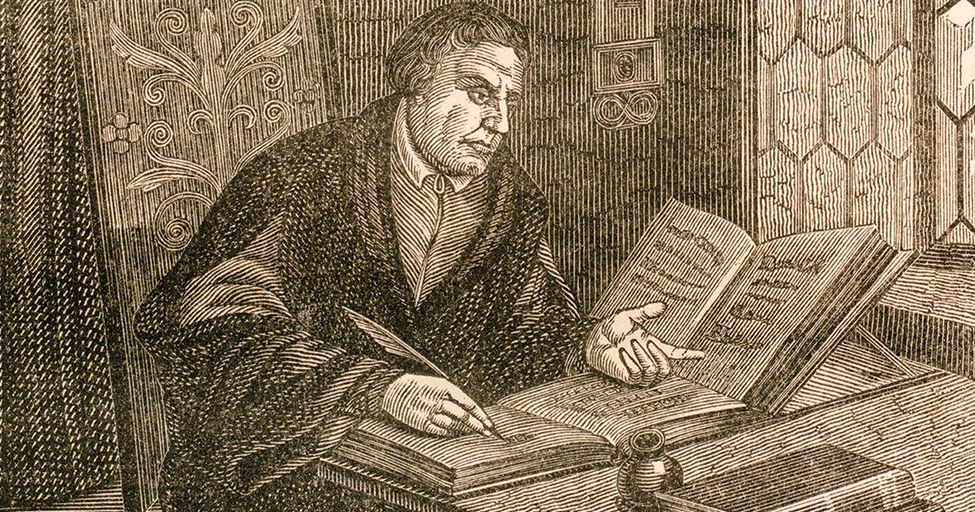
Martin Luther, to All Faithful and Godly Pastors and Preachers:
Grace, Mercy, and Peace in Jesus Christ, our Lord.
The deplorable, miserable condition which I discovered lately when I, too, was a visitor, has forced and urged me to prepare [publish] this Catechism, or Christian doctrine, in this small, plain, simple form. Mercy! Good God! What manifold misery I beheld! The common people, especially in the villages, have no knowledge whatever of Christian doctrine, and alas! many pastors are altogether incapable and incompetent to teach [so much so, that one is ashamed to speak of it]. Nevertheless, all maintain that they are Christians, have been baptized and receive the [common] holy Sacraments. Yet they [do not understand and] cannot [even] recite either the Lord’s Prayer, or the Creed, or the Ten Commandments; they live like dumb brutes and irrational hogs; and yet, now that the Gospel has come, they have nicely learned to abuse all liberty like experts.
Wow! He’s not pulling any punches here! In his last sentence he mentions the Lord’s Prayer, the Creed, or the Ten Commandments. Things all believers need to be familiar with.
Harry Blamires, a student of C.S. Lewis at Oxford, penned a book entitled, The Christian Mind. The opening sentence in the book states, “There is no longer a Christian mind.” His point being that when it comes to thinking, the modern-day Christian has become much less religious than in the past.
In the Gospels, Jesus quotes from Deuteronomy to answer the question, “What is the greatest commandment?” His response was, “You must love the Lord your God with all your heart, all your soul, and all your mind. He adds the words “all your mind” in the Gospel accounts.
Several years ago, I discovered a book by James Emery White, entitled “A Mind for God.” In his discussion on the importance of cultivating a Christian mind there is a core of knowledge that every Christian should know. He breaks it down into three categories.
Biblical Literacy
God gave us the ten commandments; we need to know what they are – along with Jesus’ Sermon on the Mount, the seven letters to the seven churches, the wisdom of Proverbs, the great theological treatise of Romans, the evangelistic thrust of John’s gospel and everything else in the canon.
Historical Literacy
Beyond biblical literacy, there are certain events in history, specifically Christian history, that should be known. Not simply names and dates, but more importantly significance. From historian, Mark Noll, comes these twelve: the fall of Jerusalem (AD70); the Council of Nicaea (325); the Council of Chalcedon (451); Benedict’s Rule (530); the coronation of Charlemagne (800); the great schism between the Eastern and Western Church (1054); the Diet of Worms (1521); the English Act of Supremacy (1534); the founding of the Jesuits (1540); the conversion of the Wesleys (1738); the French Revolution (1789); and the Edinburgh Missionary Conference (1910).
Theological Literacy
In pulling this together, theology has traditionally organized itself in ten categories: (1) existence, nature and attributes of God (theology proper); (2) revelation (the inspiration and authority of Scripture); (3) creation and providence; (4) humanity and human nature; (5) original and actual sin; (6) the person and work of Christ; (7) sin and grace; (8) the person and work of the Holy Spirit, (9) the church; and (10) the end times.
Perhaps over the summer you can carve out some time to start or renew the habit of reading. If so, the following is a suggested list as abridged from A Mind for God.
Basic Foundation (this is a good start)
- How to Read a Book; Adler, Mortimer. A primer on how to read various types of books, including the skills involved in reading a book at the level it deserves.
- Mere Christianity; C.S. Lewis. A classic explanation of, and apologetic for orthodox Christianity.
- Knowing God; Packer, J.I. A foundational theology on the doctrine of God.
- Escape from Reason; Schaeffer, Francis. Schaeffer’s seminal work on the reasons for the demise of Western thought.
- Turning Points; Noll, Mark. Covers all the events listed above under Historical Literacy.
- The Cost of Discipleship; Bonhoeffer, Dietrich.
- Overcoming Sin and Temptation; Owen, John. (Great stuff. Not a book for the faint of heart!)
- A Mind for God; White, James Emery
Books Toward a Christian Worldview
- The Well-Educated Mind; Bauer, Susan
- The Christian Mind; Blamires, Harry
- How Now Shall We Live? Colson, Charles
- The God Who Is There; Schaeffer, Francis
- The Hiding Place; ten Boom, Corie
A Couple of Good Biographies
- Bonhoeffer; Metaxas, Eric (Great book about Bonhoeffer’s life and the rise of the Nazis in 1930s Germany)
2. Martin Luther; Metaxas, Eric (The life of the firebrand that kicked off the Reformation)
Bill Erickson
 Devotional Blog